In high-voltage electrical substations, tubular aluminum busbars and flat copper bars serve as the primary conductors connecting power transformers, circuit breakers, and disconnect switches. Operating under continuous heavy electrical loads, these rigid busbars undergo significant temperature fluctuations caused by Joule heating and changing ambient weather.
If rigid busbar runs lack proper expansion hardware, thermal expansion and contraction generate massive axial forces. These mechanical stresses are transmitted directly into transformer bushings and post insulators, risking ceramic cracking, oil leakage, or structural misalignment.
This technical guide analyzes the mechanics of busbar thermal expansion, the damping role of flexible expansion clamps, and best practices for preventing galvanic corrosion at bimetallic junction points.
1. Mechanics of Busbar Thermal Expansion in Substations
Aluminum and copper busbars expand and contract predictably along their length according to their linear coefficient of thermal expansion (α). The thermal length change (ΔL) is calculated using the standard formula:
ΔL = α × L × ΔT
Where:
- α = Linear thermal expansion coefficient (23 × 10^-6 / K for aluminum; 16.5 × 10^-6 / K for copper).
- L = Total length of the rigid busbar run (m).
- ΔT = Temperature variance between maximum operating load and minimum ambient winter temperature (K).
For a 30-meter aluminum tubular busbar operating across a 60°C temperature span, total thermal elongation reaches over 41 mm. Without flexible expansion joints, this thermal expansion exerts thousands of Newtons of axial thrust on delicate substation equipment terminals, as specified in the IEEE Guide for Substation Bus Design.
2. Rigid Clamps vs. Flexible Expansion Clamps
To protect substation infrastructure, engineers divide continuous busbar runs into distinct thermal zones using specialized busbar hardware:
- Rigid Busbar Clamps: Used at anchor points to fix the busbar position securely on support insulators. They transfer transverse wind loads and short-circuit electromagnetic forces to the structure.
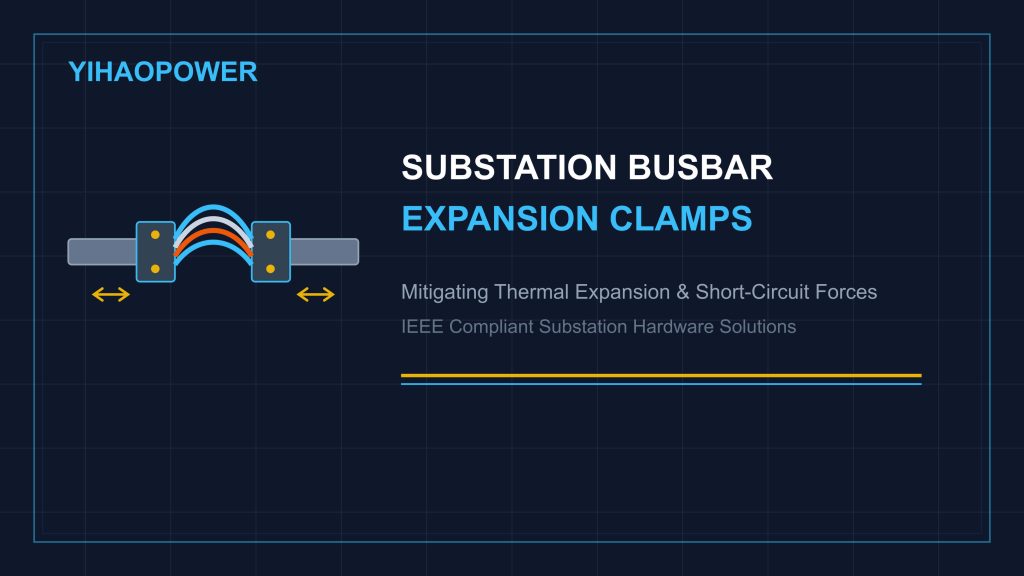
- Flexible Expansion Clamps: Installed at floating support points and terminal connections to transformer bushings. Constructed with multi-layered laminated aluminum or copper straps, flexible clamps absorb axial movement while maintaining full electrical current carrying capacity.
Absorbing Short-Circuit Electromagnetic Forces
During a grid short-circuit fault, peak fault currents create extreme electromagnetic repulsion forces between adjacent phases. Flexible expansion clamps act as mechanical shock absorbers, preventing dynamic mechanical shock from snapping porcelain insulator sheds.
3. Preventing Galvanic Corrosion at Bimetallic Interfaces
Substation connections frequently join dissimilar metals, such as joining aluminum busbars to copper transformer stud terminals. In outdoor environments, moisture triggers galvanic corrosion, leading to high-resistance contact points and thermal overheating.
- Bimetallic Transition Plates (Cu-Al): High-quality expansion clamps feature molecularly bonded copper-aluminum transition plates or silver-plated contact palms.
- Contact Surface Preparation: Field crews must coat contact faces with conductive grease (neutral petrolatum paste) and apply specified tightening torque on hot-dip galvanized or stainless steel clamping bolts.
4. Precision Blueprint Fabrication & Direct Sample Evaluation
At YIHAOPOWER, we specialize in manufacturing high-conductivity aluminum alloy busbar clamps, expansion fittings, and substation accessories engineered to exact project blueprints.
The YIHAOPOWER Manufacturing Advantage
- High Electrical Conductivity: Cast from premium A356/A356.2 aluminum alloy, heat-treated for high mechanical yield strength and low magnetic loss.
- Smooth Anti-Corona Finish: All busbar clamp surfaces and hardware edges are polished smooth to prevent corona discharge and radio interference at high voltage levels (110 kV to 500 kV).
- 100% Pre-Shipment Fitting Checks: Every batch undergoes dimensional alignment and bolt-hole clearance inspection before export packing to ensure zero-defect job-site installation.
- Direct Sample Delivery: We invite utility engineers, substation project managers, and EPC contractors to request direct sample deliveries shipped straight to your office or warehouse. Evaluate casting density, flexible strap resilience, and surface finish on your physical terminal samples before placing volume orders.
Ready to inspect substation accessory samples or request technical drawings for your upcoming grid project? Contact YIHAOPOWER Team today for factory-direct quotes and direct sample arrangements.
Need Customized Hardware or Technical Datasheets?
Contact our team directly for instant quotations, CAD drawings, and samples.