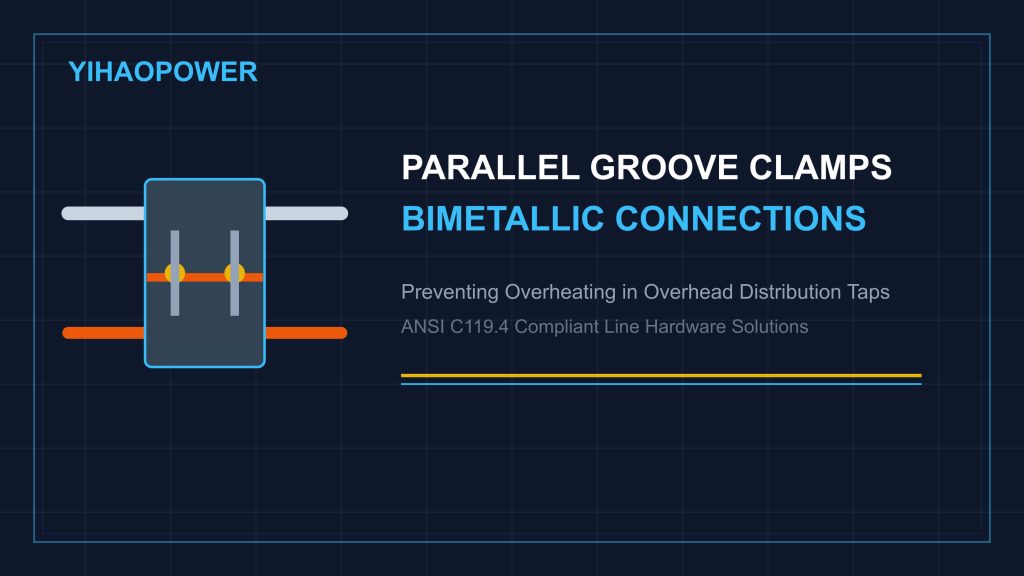
In overhead electricity distribution networks, parallel groove clamps (PG clamps) serve as essential non-tension connectors. They are widely used for joining parallel conductors, creating line branch taps, and making jumper connections at transformer poles and disconnect switches.
However, field maintenance logs show that connection taps are among the most frequent failure points on distribution lines. When joining dissimilar metals—such as an aluminum main line to a copper branch drop—improper clamp selection causes severe galvanic corrosion and high electrical resistance, leading to joint overheating and line burn-offs.
This technical guide analyzes the mechanics of bimetallic contact resistance, the structural design of parallel groove clamps, and best practices for long-term joint reliability.
1. The Challenge of Bimetallic Galvanic Corrosion in Line Taps
When aluminum and copper conductors come into direct contact in the presence of moisture and airborne pollutants, a galvanic cell is established. Because aluminum has a significantly lower electrochemical potential than copper, the aluminum conductor acts as a sacrificial anode and corrodes rapidly.
How Bimetallic Corrosion Causes Joint Breakdown
- Oxide Layer Formation: As moisture penetrates the unsealed contact area, aluminum oxide ($Al_2O_3$) builds up at the interface.
- Rising Contact Resistance: Aluminum oxide is a high-resistance insulator. As the effective contact surface area decreases, electrical contact resistance increases sharply.
- Thermal Runaway (Joule Heating): According to Joule’s law ($P = I^2 R$), elevated resistance converts current into extreme heat. This thermal expansion-contraction cycle loosens the clamp bolts, causing further resistance spikes until the connector melts or burns open.
To prevent this failure mode, connectors must comply with bimetallic performance criteria such as those defined in the ANSI C119.4 Standard for Electric Connectors.
2. Structural Features of Bimetallic Parallel Groove Clamps
To maintain stable electrical conductivity and physical clamping pressure across decades of outdoor exposure, PG clamps incorporate specialized engineering features:
A. Friction-Welded Bimetallic Transition Sheets
For copper-to-aluminum line connections, high-quality PG clamps utilize a copper sheet molecularly bonded (explosive or friction welded) to the aluminum alloy body. The aluminum groove contacts the aluminum main wire, while the copper-lined groove grips the copper branch tap, completely isolating dissimilar metals.
B. High-Strength Aluminum Alloy Casting
The clamp body is cast from high-strength, heat-treated aluminum alloy (A356/A356.2). This provides optimal mechanical elasticity: as wind vibrations and thermal load variations cause the conductors to expand and contract, the clamp body maintains continuous elastic clamping force without cracking.
C. Deep Wave-Shaped Grooves
Engineered with longitudinal ridges inside the conductor grooves, PG clamps break through the tough natural oxide film on aluminum wires during bolt tightening, exposing fresh metal for maximum contact surface area.
3. Field Installation Protocol for Zero-Defect Connections
Even the highest quality parallel groove clamp will fail if installed on contaminated or improperly prepared conductors. Field crews should follow these mandatory steps:
- Wire Brushing: Mechanically scrub the conductor surfaces with a clean stainless steel wire brush until the outer strands show bright, shiny metal.
- Apply Conductive Oxide Inhibitor: Immediately coat the brushed wire surfaces with a high-temperature neutral conductive grease. The grease seals out air and moisture while metallic particles within the paste lower contact resistance.
- Torque Wrench Tightening: Tighten hot-dip galvanized or stainless steel clamping bolts incrementally using a calibrated torque wrench. Over-tightening can crush aluminum strands, while under-tightening leads to thermal loosening over time.
4. Precision Manufacturing & Direct Sample Shipping by YIHAOPOWER
As a specialized manufacturer of utility power hardware, YIHAOPOWER produces precision-cast parallel groove clamps, wedge connectors, and line accessories engineered to exact project specifications.
Why Procurement Teams Work with YIHAOPOWER
- Exact Blueprint Tolerances: Custom groove dimensions matching specific ACSR, AAAC, and copper wire sizes (from 16 mm² up to 400 mm²) manufactured to precise blueprint specifications.
- Heavy Zinc Protection: Clamping bolts and washers feature uniform hot-dip galvanizing for long-term corrosion resistance in humid and industrial corridors.
- 100% Pre-Shipment Inspection: Every production batch undergoes thread clearance and body alignment checks before export packaging to guarantee smooth field assembly.
- Direct Sample Shipping: We invite utility engineers, procurement managers, and EPC project teams to request direct sample shipments sent straight to your office or warehouse. Evaluate casting density, bimetallic plate bonding, and thread fit on your physical conductor samples before placing volume orders.
Ready to inspect connector samples or request technical drawings for your upcoming line project? Contact YIHAOPOWER Team today for factory-direct quotes and direct sample arrangements.
Need Customized Hardware or Technical Datasheets?
Contact our team directly for instant quotations, CAD drawings, and samples.