In high-voltage overhead electricity transmission lines, securing insulator strings to tower crossarms requires robust, articulating mechanical links. Operating continuously under extreme atmospheric conditions and dynamic conductor tension, insulator fittings must sustain heavy tensile loads without developing structural fatigue or mechanical uncoupling.
Among these critical components, socket clevis line hardware—including socket clevises, ball eyes, ball clevises, and yoke plates—serves as the primary flexible connection connecting suspension and strain insulator assemblies to high-voltage grid towers.
This technical guide analyzes the mechanical mechanics of socket clevis line hardware, standard coupling dimensions, field assembly best practices, and sourcing protocols for international utility infrastructure.
1. Mechanical Function of Socket Clevis Line Hardware in Insulator Strings
Insulator strings on overhead transmission towers operate as dynamic mechanical links rather than rigid bars. Wind-induced conductor oscillation, thermal sag changes, and ice shedding force the insulator assembly to pivot continuously.
Articulated Flexibility and Load Transfer
Socket clevis line hardware is engineered to provide multi-axis angular flexibility:
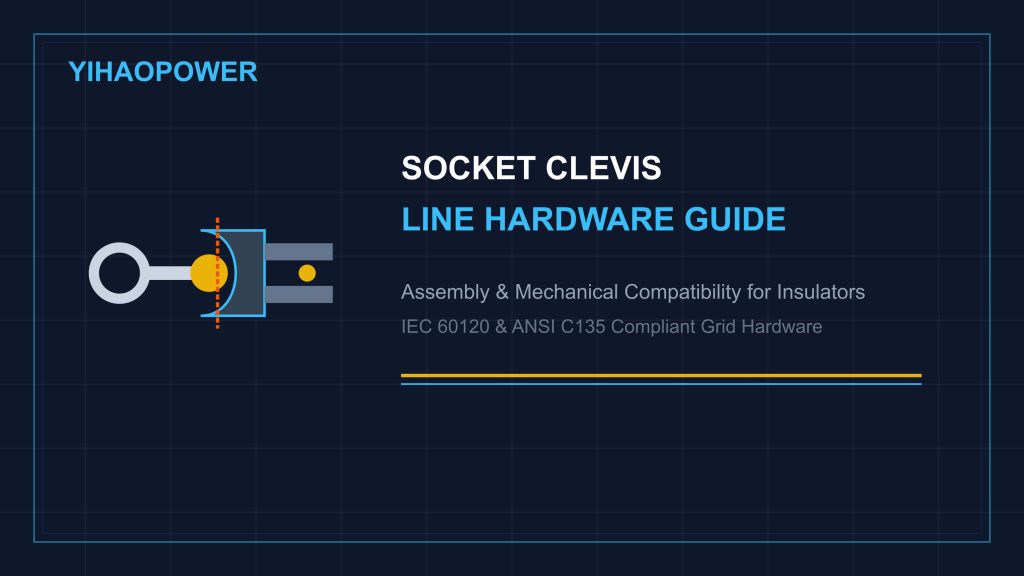
- Socket Clevis Fittings: Feature a recessed socket cavity on one end that captures the ball head of a disc insulator, while the clevis end attaches to a tower crossarm plate or yoke plate using a steel clevis pin.
- Ball Eye Fittings: Feature an eye ring on one end for attachment to tower steelwork and a ball shank on the other end that locks into the socket cavity of an adjacent insulator or fitting.
- Stress Distribution: The ball-and-socket joint allows 360-degree rotational movement and angular deflection, preventing localized bending moments from snapping fragile porcelain or toughened glass insulator discs.
Standardized Coupling Classes (IEC 60120 & ANSI C135)
To ensure seamless interchangeability across global utility grids, ball and socket dimensions adhere strictly to international coupling size classifications specified in the IEC 60120 Ball and Socket Coupling Standards.
Standard coupling pin sizes include 11 mm, 16 mm, 20 mm, 24 mm, and 28 mm, each corresponding to specific ultimate mechanical tensile ratings ranging from 70 kN to over 300 kN.
2. Drop-Forging Mechanics & Corrosion Protection Standards
Because socket clevis line hardware anchors high-voltage conductors carrying megawatts of electrical power, component failure can trigger catastrophic line drop events. Structural reliability depends heavily on forging density and metallurgical quality.
- Hot Drop-Forged Steel Construction: High-strength socket clevises and ball eyes are hot drop-forged from high-grade carbon steel (such as Grade 45 or 40Cr). Hot forging aligns the steel grain flow along the component contour, delivering high yield strength and fatigue resistance under cyclic dynamic tension.
- Hot-Dip Galvanizing (ASTM A153 / ISO 1461): To withstand decades of outdoor exposure in industrial and coastal environments, forged steel hardware is immersed in molten zinc. The hot-dip galvanized coating (averaging over 85 µm in thickness) creates a sacrificial metallurgical barrier that resists rust and atmospheric corrosion.
- Stainless Steel Locking Pins (R-Key & W-Key): To prevent accidental uncoupling caused by line vibration, socket cavities incorporate a locking pin (cotter key). Manufactured from stainless steel or phosphor bronze, these R-keys or W-keys lock the insulator ball firmly inside the socket cavity while allowing easy field installation and maintenance.
3. Common Field Assembly Errors & Misalignment Prevention
Improper installation or hardware mismatch during tower erection can compromise the mechanical integrity of the entire suspension assembly. Field crews should adhere to strict assembly protocols:
- Coupling Size Verification: Never force a 20 mm ball shank into a 16 mm socket cavity. While mis-matched components may appear to connect, the reduction in contact surface area causes severe stress concentration and premature mechanical shearing under peak tension.
- Locking Pin Engagement: Ensure the stainless steel cotter key is pushed fully into the locked position inside the socket housing. An incompletely engaged locking pin can vibrate out during high winds, leading to catastrophic insulator uncoupling.
- Inspecting Zinc Coverage inside Sockets: Check that the internal socket cavity is free from heavy zinc dross, burrs, or metal debris that could restrict the free rotation of the mating ball head.
4. Precision Blueprint Fabrication & Direct Sample Evaluation by YIHAOPOWER
As a specialized B2B manufacturer of transmission line accessories, YIHAOPOWER produces precision-forged socket clevis line hardware, ball fittings, and tower line hardware built in accordance with international utility specifications.
The YIHAOPOWER Manufacturing Advantage
- Exact Blueprint Compliance: Custom shank lengths, eye hole diameters, and socket coupling sizes manufactured to exact project drawings.
- 100% Pre-Shipment Trial Fitting: Every production batch undergoes manual ball-and-socket trial fitting, clevis pin alignment checks, and locking pin clearance inspection before export packaging to guarantee zero-defect job-site assembly.
- Direct Sample Shipping: We invite utility engineers, procurement managers, and EPC project teams to request direct sample deliveries shipped straight to your office or warehouse. Evaluate forging density, locking pin action, and zinc coating finish on your physical insulator samples before placing volume orders.
Ready to inspect hardware samples or request technical drawings for your upcoming transmission line tender? Contact YIHAOPOWER Team today for factory-direct quotes and direct sample arrangements.
Need Customized Hardware or Technical Datasheets?
Contact our team directly for instant quotations, CAD drawings, and samples.